

Senior Manager Course in National Security Leadership
Course Overview
The Senior Manager Course in National Security Leadership (Senior Manager Course) sharpens analytical and leadership skills, preparing participants to translate strategic intent into operational action in joint, interagency, and international environments. Participants refine their understanding of the three concentric circles of the strategic environment: interagency processes, the wider U.S. policy community, and the international context. By focusing on leading people, leading change, and building coalitions, the course prepares its alumni for enterprise leadership roles in their organizations.


Course Curriculum
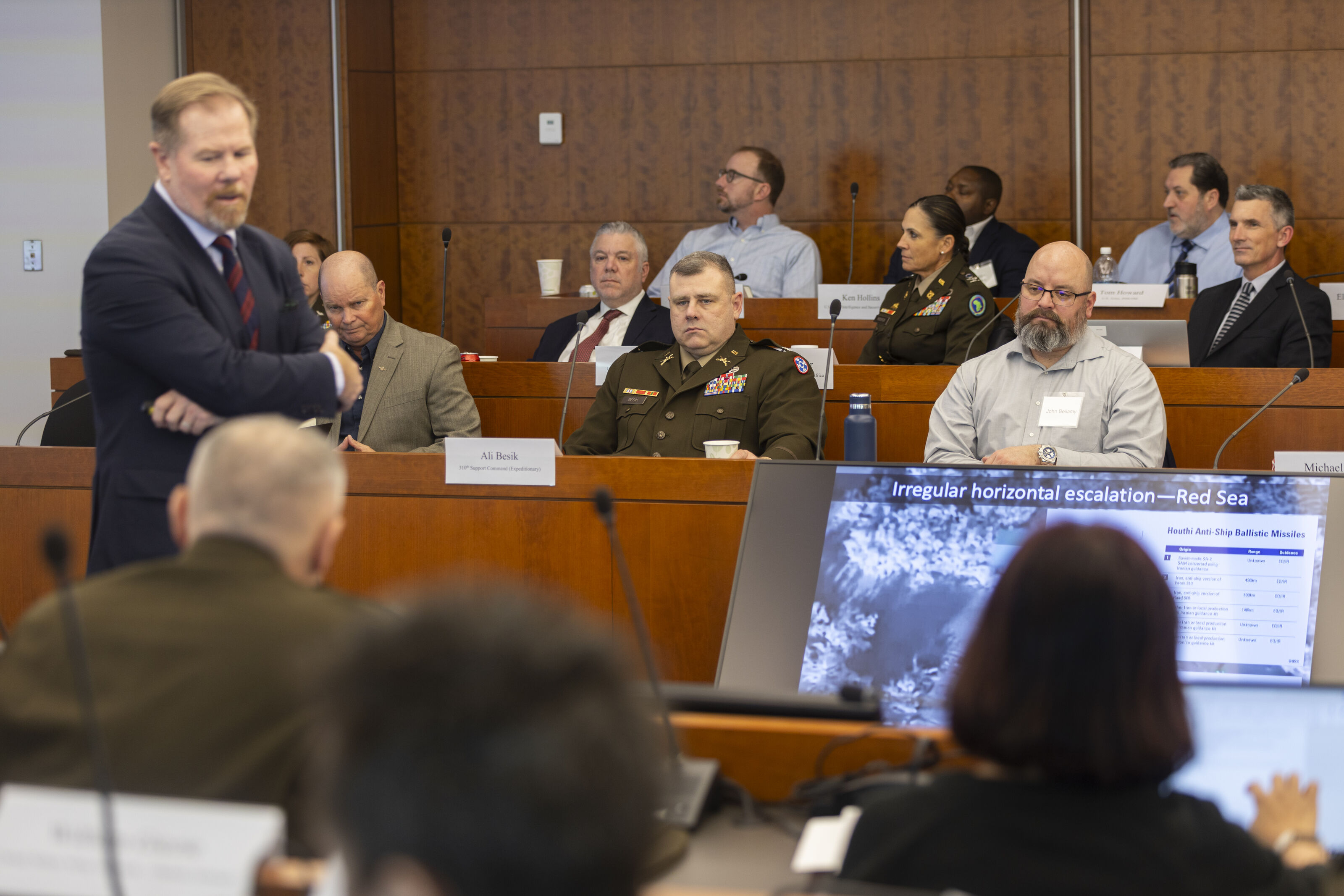
During the two-week course, participants attend lectures by internationally-renowned national security experts, travel to international embassies and Capitol Hill, and practice strategic communication skills in mock interviews at a Washington, DC commercial broadcast studio. The course concludes with a multi-day interagency crisis simulation in which participants assume the roles of executive branch officials, Senators, journalists, and interest group representatives. Senior mentors who are distinguished current and former officials guide participants through the exercise to ensure a comprehensive understanding of how competing actors shape the strategic environment. Past simulation topics include Commanding Heights: Confrontation in the Arctic, Baltics on the Brink, and Crisis in Kashmir. Throughout the course, participants network with distinguished peers and policy experts, strengthening connections and a shared understanding of the broader national security mission.
June 2025 Senior Manager Course in National Security Leadership
Week 1
| Breakfast at leisure | |
| Topic | Navigating Complexity |
| Location | Room 211 |
| 0800-0900 | Registration |
| 0900-1030 | Introductions and Course Overview |
| 1100-1230 | Historical Thinking & National Security Leadership Jeremi Suri, University of Texas, Austin |
| 1230-1400 | Lunch at DACOR Bacon House |
| 1400-1630 | Navigating Complexity David Kilcullen, Cordillera Applications Group |
| 1700-1930 | Opening Dinner & Keynote Address: Demographics and Leadership ADM (Ret.) Michelle Howard |
| Breakfast at leisure | |
| Topic | Formulating Strategy I |
| Location | Room 211 |
| 0845-0900 | Recap and Preview of Day |
| 0900-1030 | NeuroLeadership: Building Effective Coalitions David Rock, NeuroLeadership Institute |
| 1100-1230 | Civil-Military Relations Mara Karlin, JHU-SAIS |
| 1230-1400 | Lunch at DACOR Bacon House |
| 1400-1600 | The Future of Multilateralism Stewart Patrick, Carnegie Endowment for International Peace; Aude Darnal, Stimson Center |
| Breakfast at leisure | |
| Topic | Forging Coalitions |
| Location | Room 211 |
| 0845-0900 | Recap and Preview of Day |
| 0900-1030 | Strategic Narrative Matthew Levinger, GWU |
| 1100-1230 | The National Security Budget Todd Harrison, American Enterprise Institute |
| 1230-1400 | Lunch |
| 1400-1515 | The Media Landscape and Foreign Policy Decision-Making Thom Shanker, GWU |
| 1530-1645 | Embassy 101: Communicating with International Diplomats COL Jonathan Dunn, Office of Chief of Staff of the Army |
| 1700-2000 | Optional Session: Working With the Media Maxine Hughes and Sarah Firth |
| Breakfast at leisure | |
| Topic | Congress and U.S. Foreign Policy |
| Location | Capitol Hill |
| 0830-0900 | TRAVEL TO CAPITOL HILL |
| 0900-1230 | Capitol Hill Visit |
| 1330-1430 | Lunch on Capitol Hill |
| 1430-1630 | Capitol Hill Visit |
| 1700-2000 | Optional Session: Working With the Media Maxine Hughes and Sarah Firth |
| Breakfast at leisure | |
| Topic | Transnational Challenges I |
| Location | Embassies & Elliott School Room 211 |
| 0845-0900 | TRAVEL TO EMBASSIES |
| 0900-1230 | Embassy Visits |
| 1230-1430 | Lunch |
| 1430-1630 | Climate Change and National Security Chris Greig, Princeton University; CAPT (Ret.) Steve Brock, Center for Climate & Security |
Week 2
| Breakfast at leisure | |
| Topic | Formulating Strategy II |
| Location | Room 211 |
| 0845-0900 | Recap and Preview of Day |
| 0900-1045 | Strategy Formulation Celestino Perez, U.S. Army War College |
| 1100-1300 | China: Balancing Competition and Cooperation Bonnie Glaser, GMFUS; Rush Doshi, Council on Foreign Relations |
| 1300-1430 | Lunch at DACOR Bacon House |
| 1430-1630 | Security Challenges in the Middle East Steven Cook, Council on Foreign Relations; Karim Sadjadpour, Carnegie Endowment for International Peace |
| 1700-2000 | Optional Session: Working With the Media Maxine Hughes and Sarah Firth |
| Breakfast at leisure | |
| Topic | Transnational Challenges II |
| Location | Room 211 |
| 0845-0900 | Recap and Preview of Day |
| 0900-1030 | Emerging Technologies and Great Power Competition Jeffrey Ding, GWU |
| 1100-1230 | Arctic Security Pavel Devyatkin, The Arctic Institute |
| 1230-1400 | Lunch |
| 1400-1600 | Uneasy Coexistence: The Future of U.S.- Russia Relations George Beebe, Quincy Institute for Responsible Statecraft; Evgeny Roshchin, Center for European Policy Analysis |
| Breakfast at leisure | |
| Topic | Simulation Exercise I |
| Location | Room 211 |
| 0845-0900 | Recap and Preview of Day |
| 0900-1030 | Negotiation Challenges of Nuclear Arms Control and Counterproliferation Amb. Bonnie Jenkins, GWU |
| 1100-1230 | Negotiation Skills for Senior Leaders Anthony Wanis-St. John, American University |
| 1230-1400 | Lunch: Leading Strategically in National Security Crisis Amb. Douglas Lute, BGR Group |
| 1400-1630 | Simulation Exercise |
| Breakfast at leisure | |
| Topic | Simulation Exercise II |
| Location | Elliott School 2nd, 3rd & 6th Floors |
| 0845-0900 | Recap and Preview of Dat |
| 0900-1230 | Simulation Exercise |
| 1230-1400 | Working Lunch |
| 1400-1630 | Simulation Exercise |
| 1730-2000 | Farewell Dinner The Hamilton |
| Breakfast at leisure | |
| Topic | Lessons Learned; the Path Forward |
| Location | Room 211 |
| 0900-1030 | Simulation Debrief |
| 1100-1230 | Space Policy Doug Loverro, Loverro Consulting LLC |
| 1230-1430 | Lunch at DACOR Bacon House |
| 1400-1530 | Concluding Remarks & Hotwash |
Our latest course agenda, shown above, provides a comprehensive overview of the course. Please note, the agenda above represents the most recent course schedule. Each year, our course agenda evolves to align with changes to the national and global security environment.
Recommended Applicants
The Senior Manager Course in National Security Leadership is open to military and government personnel at the O-5/6, GS-14/15 levels or above, and equivalent levels for international and private-sector participants.
Participants represent a wide range of U.S. agencies and organizations, including:
- U.S. Army
- U.S. Air Force
- U.S. Navy
- U.S. Marine Corps
- National Guard Bureau
- Office of the Secretary of Defense
- U.S. Northern Command
- U.S. Southern Command
- U.S. European Command
- Department of Homeland Security
- Department of Energy
- Central Intelligence Agency
- National Security Agency
- National Geospatial Intelligence Agency
- National Reconnaissance Office
- Defense Threat Reduction Agency
- National Nuclear Security Administration
- Defense Information Systems Agency
- Defense Technology Security Administration
- Johns Hopkins University Applied Physics Laboratory
- Sandia National Laboratories
- Los Alamos National Laboratory
- Institute for Defense Analyses
Recent international participants include representatives of the following:
- NATO
- Canada
- Denmark
- Finland
- Germany
- Hungary
- Iceland
- The Netherlands
- Norway
- Romania
- Türkiye
- United Kingdom
- Australia
- Indonesia
- Singapore
- Ethiopia
- Kenya
- Mauritania
- Senegal
- Saudi Arabia
- United Arab Emirates


Course Fee
The course fee is $9,900 and includes tuition, curricular materials, and most meals.
Course Dates
The Senior Manager Course in National Security Leadership is offered twice each year in March and June. For specific course dates, please visit our Apply Today page.
What Participants Are Saying
"As a professional in public and congressional affairs and strategy, I found the Senior Manager Course in National Security Leadership to be truly exceptional - far exceeding my expectations. The program was a dynamic blend of academic rigor and real-world application which deepened my understanding of national security decision-making at the highest levels. In-class sessions were led by engaging, highly qualified experts with deep experience across the spectrum of national security. A day-long visit to Capitol Hill provided direct dialogue with a sitting U.S. Representative and access to congressional chambers. A professional mock media interview offered invaluable insight into strategic communication under pressure. A foreign embassy visit added an international perspective and provided diplomatic insights. The final case study was fast-paced and immersive, simulating global crises in a rapidly evolving environment where we explored how the Office of the Secretary of Defense and Congress might respond amid media scrutiny and competing interests. This course has sharpened my strategic thinking and broadened my perspective - skills that directly enhance my effectiveness. This course is not just informative - it’s transformative!"
Johnnie Bradt
Director, Public and Congressional Affairs
US Army Aviation and Missile Command
"The course was a two-week academic firehouse. We focused on three learning objectives: Understanding the Strategic Environment, Enhancing leadership and management skills and Master analytical and problem solving tools. All this was done through daily lectures, exercises and essential readings. We dove into the 'snakes and dragons' of modern insurgency with David Kilcullen, wrestled with the '1492 moment' in space policy, and had our social brains deconstructed by the NeuroLeadership Institute… I had one of those 'wow' moments where I realized just how big the world is and, honestly, how much I still have to learn."
Joe Salazar
S-3 Engineering Division Chief, 106th Signal Brigade